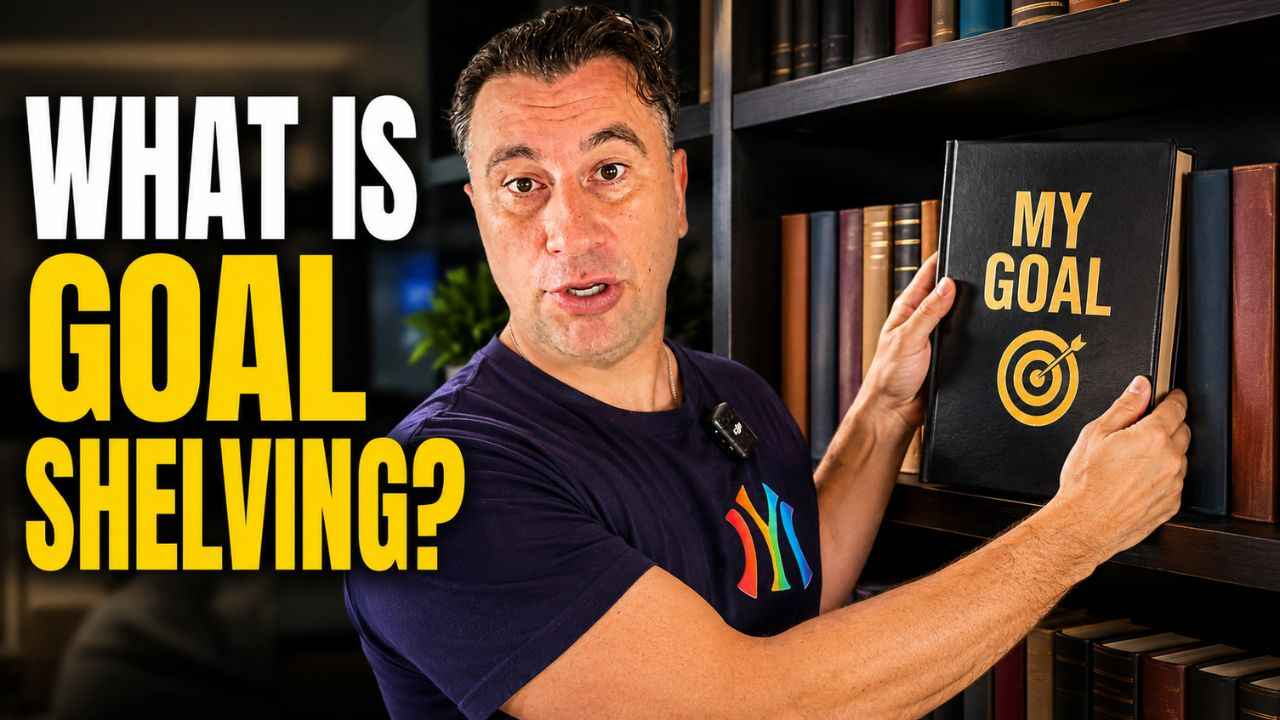
What is Goal Shelving?
Where Psychology and Manifestation Collide
What is Goal Shelving? On the surface, the phrase sounds simple. You have a goal, something changes, and instead of continuing to pursue it, you put it aside. Maybe you tell yourself you'll return to it when you have more money, when life becomes easier, when the timing is better, or when you've solved whatever problem currently demands your attention. The goal hasn't necessarily disappeared. It's simply no longer occupying the same position in your life.
But that raises a much bigger question for manifestation. What happens when you continue believing that something is your goal while your actual life has gradually reorganized itself around not having it? You can visualize it, affirm it, talk about it, create vision boards around it, and continue calling it your dream—but is it still an active destination within your identity, or has it quietly been placed on a psychological shelf?
That's what makes Goal Shelving such an interesting bridge between psychology and manifestation. It forces us to look beyond what someone consciously says they want and examine what their behavior, decisions, priorities, and identity are actually organized around. And that distinction may explain something important about why certain goals remain “important” to us for years without ever becoming part of our lived reality.
- What Is Goal Shelving?
- Why Do People Put Goals on the Shelf?
- Where Psychology and Manifestation Collide
- Goal Shelving and Your Identity
- Can You Still Manifest a Goal You've Shelved?
- How to Recognize Goal Shelving in Your Own Life
- Taking a Goal Back Off the Shelf
- Final Thoughts: What Is Goal Shelving?
What is Goal Shelving?
Goal Shelving refers to putting a goal aside rather than necessarily eliminating it altogether. The distinction matters because abandoning something and shelving something are psychologically different experiences. When you abandon a goal, you've made some degree of decision that you're finished with it. When you shelve it, the goal can remain available in your mind as something you may pursue again later.
Think about how often this happens in ordinary life. Someone wants to start a business but decides they'll do it after their finances improve. Someone wants to move overseas but keeps postponing the move until circumstances feel safer. Someone wants to become financially independent but spends years dealing with immediate problems that continually push the larger goal further into the future. The original desire can remain completely genuine while the person's active life moves in another direction.
This is where the concept becomes more important than simply procrastination. Procrastination usually describes delaying an action that you're still expected to perform. Goal Shelving can involve a much larger change in the status of the goal itself. The goal moves from something around which you're actively organizing your life to something you're preserving for an undefined future.
And sometimes that happens so gradually that you don't recognize you've done it.
Why Do People Put Goals on the Shelf?
People don't always shelve goals because they stop wanting them. Life competes for attention. Financial problems arise. Relationships change. Careers demand more time. Families create responsibilities. Failure changes our expectations. Something that once felt immediately possible can gradually become something we tell ourselves we'll pursue “eventually.”
That word—eventually—can become extremely powerful.
Eventually allows us to maintain an emotional connection to a goal without requiring us to confront whether our present life is actually moving toward it. We can continue thinking of ourselves as someone who wants to write the book, build the business, become wealthy, move somewhere new, find the relationship, or completely transform our life while repeatedly making decisions that preserve our current circumstances.
This doesn't automatically mean someone is lazy, afraid, or subconsciously sabotaging themselves. Sometimes shelving a goal is completely rational. Circumstances really do change, and temporarily redirecting attention can be the intelligent decision.
The more interesting question is whether the shelf is temporary—or whether it has quietly become permanent.

Work with Chad
Tired of struggling with finances or feeling stuck in life? Chad can help you break free, grow your wealth, improve your health, and create lasting prosperity. Click now to change your story!
Where Psychology and Manifestation Collide
This is where Goal Shelving and manifestation become particularly interesting.
Manifestation teachings frequently emphasize maintaining the assumption of the fulfilled desire. Neville Goddard's Law of Assumption, for example, places enormous importance on identifying with the state in which the desired outcome is already true. Modern identity work often translates this into becoming the version of yourself who already has the result you want.
But psychology asks us to look at what we're actually doing.
If I claim that becoming financially successful is one of the defining goals of my life, but I've reorganized my decisions around merely surviving, what goal is functionally controlling my behavior?
If I say I intend to build a business but repeatedly construct my life around avoiding the uncertainty required to build one, where does that goal actually exist?
If I say I'm becoming a completely different version of myself while continually postponing every decision associated with that identity, have I changed my identity—or have I preserved the new identity as a future possibility?
That doesn't automatically disprove manifestation. It creates a more useful question about the relationship between desire, identity, and behavior.
Goal Shelving and Your Identity
Goals aren't completely separate from identity. The goals we repeatedly pursue influence what we do, where we spend our time, what sacrifices make sense to us, what opportunities we notice, and ultimately what kind of person we believe ourselves to be.
That's why shelving a sufficiently important goal can affect much more than the goal itself.
Imagine someone spends years thinking of themselves as an entrepreneur. They intend to build their own company and construct a completely different financial life. After several setbacks, however, the business goal gets pushed aside. They don't officially give up. They continue saying, “I'm going to do it.”
But another year passes.
Then another.
Eventually their routines, financial decisions, relationships, expectations, and sense of security may become increasingly organized around the life they're currently living. The entrepreneurial goal still exists mentally, but it occupies less and less space behaviorally.
At some point, the important question becomes:
Which identity is actually running the person's life?
That question is extremely relevant to manifestation because identity work isn't merely about selecting a more attractive description of yourself. A meaningful identity influences how you interpret situations and how you respond to them.

no fluff. no spam. just one weekly mindset drop to help you break patterns, shift identity, and take power back
No Spam.
Unsubscribe anytime.
But let's be real - you won't want to.
Can You Still Manifest a Goal You've Shelved?
This is where I wouldn't reduce the conversation to a simple yes or no.
Shelving a goal doesn't necessarily mean you've stopped wanting it, and it certainly doesn't prove that the goal can never become important again. People return to abandoned projects, old ambitions, relationships, careers, creative work, and dreams all the time.
The more useful question is whether you've unknowingly changed your relationship with the goal.
There's a major psychological difference between:
“This is where I'm going.”
and:
“Someday, I'd still like this to happen.”
Those statements can describe exactly the same desired outcome while representing completely different relationships to it.
From a manifestation perspective, that distinction becomes especially interesting. If your conscious mind keeps calling something your primary desire while your identity has gradually repositioned it as an optional future possibility, repeating more affirmations may not address the actual issue.
You may first need to recognize that the goal has been shelved.
How to Recognize Goal Shelving in Your Own Life
The easiest mistake would be assuming that every delayed result means you've shelved the goal. That's not necessarily true. Some meaningful goals take years, encounter setbacks, or require periods when visible progress is limited.
Instead, look at the role the goal currently occupies in your life.
Do your important decisions still account for it? Do you behave as though this future remains relevant? Have you repeatedly moved the starting date forward? Do you primarily interact with the goal through thinking, visualization, planning, or consuming content rather than through your actual life? Have you created a comfortable story explaining why the goal is still yours despite no longer organizing anything around it?
Those questions aren't meant to create guilt. They're useful because they separate wanting an outcome from having an active relationship with an outcome.
You can deeply want something you've nevertheless placed on the shelf.
Recognizing that distinction gives you the opportunity to decide what happens next.

Power wealth classics
Struggling to achieve financial freedom or live the life you deserve? Power Wealth Classics is your ultimate guide to timeless principles of success and abundance. Available now on Amazon, this book combines proven strategies and insights from history's greatest minds to help you break free from limitations, build wealth, and create lasting prosperity. Don’t wait—transform your life today!
Taking a Goal Back Off the Shelf
Getting a goal off the shelf doesn't necessarily mean attacking it with massive action tomorrow. It means restoring the goal to an active position in your life.
That begins by making an honest decision about whether you still want it.
Not whether the younger version of you wanted it. Not whether you've already invested years talking about it. Not whether abandoning it would make you feel like you failed.
Do you still choose this goal now?
If the answer is yes, then the next question becomes whether your present identity and decisions reflect that choice. A goal doesn't have to dominate every hour of your life to remain active, but it should have some meaningful relationship with how you're living.
From the manifestation perspective, this is where the conversation becomes much deeper than simply “thinking positive.” You're bringing your stated desire, identity, assumptions, decisions, and actual life back into relationship with one another.
You're taking the goal off the shelf.
Final Thoughts:
What Is Goal Shelving?
So, what is Goal Shelving? At its simplest, it's the process of placing a goal aside without necessarily eliminating the desire for it. But when we examine Goal Shelving through psychology and manifestation, the concept exposes a much bigger question: Can something remain your goal psychologically even when you've stopped organizing your life around becoming the person who achieves it?
That's why this idea matters for identity work and manifestation. Sometimes the problem isn't that you've stopped wanting your dream. You may still think about it constantly. You may still believe it's possible. You may even continue practicing manifestation techniques around it.
But somewhere along the way, the goal may have moved from something you're becoming to something you're remembering.
And recognizing that difference may be the first step toward deciding whether that goal belongs back in your life.
🔗 Related Resources

Chad Napier
I'm here to help you unlock Wealth, Health & Prosperity by mastering your mindset and living life on YOUR terms. If you're ready to break free from the ordinary—you’ve found your Tribe.