What Is Goalodicy?
The Dark Side of Success and Manifestation
We are taught something incredibly powerful about success: don't quit. When things aren't working, keep going. When other people doubt you, keep going. When circumstances look impossible, keep going. Some of the greatest success stories ever told are built around people who continued long after almost everyone else would have stopped.
Manifestation appears to take that principle even further. If your current 3D reality doesn't reflect what you want, you're not necessarily supposed to accept those circumstances as the final truth. You maintain your desired end. You don't allow today's evidence to determine tomorrow's possibilities. And on the surface, that sounds like an incredibly powerful philosophy for creating the life you want.
But there is an uncomfortable question hiding inside all of this: Can you become so committed to getting what you want that you eventually lose the ability to recognize something important happening right in front of you? And if so, how do you distinguish between the moment when you need to persist and the moment when persistence itself may be leading you in the wrong direction?
That's where the question “What is Goalodicy?” becomes so interesting. It introduces a largely unfamiliar idea into a conversation dominated by persistence, belief, determination, and refusing to accept current circumstances. And when we put that idea beside manifestation, something surprising happens: two ways of looking at goals that initially seem to contradict each other may reveal a distinction that completely changes how we think about pursuing what we want.
What Is Goalodicy?
Goalodicy is a concept associated with organizational psychologist Christopher Kayes and his research into excessive goal pursuit. At its core, Goalodicy examines what can happen when commitment to a goal becomes so powerful that continuing to pursue it becomes increasingly difficult to question, even when circumstances begin suggesting that the current course of action may no longer make sense. Instead of stepping back and objectively reevaluating the situation, a person can become even more committed to continuing.
That doesn't mean persistence itself is bad. Persistence is one of the fundamental requirements for achieving difficult things. Building a business, changing your financial situation, developing a career, transforming your life, or accomplishing almost any ambitious goal will involve periods when the evidence isn't favorable. If everyone abandoned their goals whenever progress became difficult, very few meaningful goals would ever be accomplished. The real problem is that there isn't always an obvious line separating healthy persistence from destructive persistence.
The longer you've pursued something, the more you may have invested in it. That investment isn't only financial. You've invested time, energy, reputation, sacrifice, emotion, and perhaps years of your life. You may have told everyone what you're going to accomplish. You may even have built part of your identity around becoming the person who achieves it. As those investments accumulate, changing direction can become psychologically more difficult because changing direction no longer feels like simply changing a strategy. It can begin to feel like everything you've invested was wasted.
This is where Goalodicy challenges the traditional success principle of “never give up.” There may be circumstances where the very persistence that normally helps someone succeed also makes it harder for that person to recognize when something needs to change. Instead of asking, “Is this still the best path toward what I want?” the person begins asking only, “What do I need to do to keep this particular path alive?” That subtle difference can completely change the way someone evaluates opportunities, problems, risks, and alternatives.

Work with Chad
Tired of struggling with finances or feeling stuck in life? Chad can help you break free, grow your wealth, improve your health, and create lasting prosperity. Click now to change your story!

The Story Behind Goalodicy
One of the most powerful stories associated with What is Goalodicy comes from Kayes's analysis of the 1996 Mount Everest disaster. Everest created an extreme environment for examining goal pursuit because the objective couldn't have been much clearer: reach the summit. Climbers had invested enormous amounts of preparation, money, physical training, sacrifice, and emotional energy into reaching that single point on the mountain. For many of them, standing near the summit represented the culmination of years of preparation.
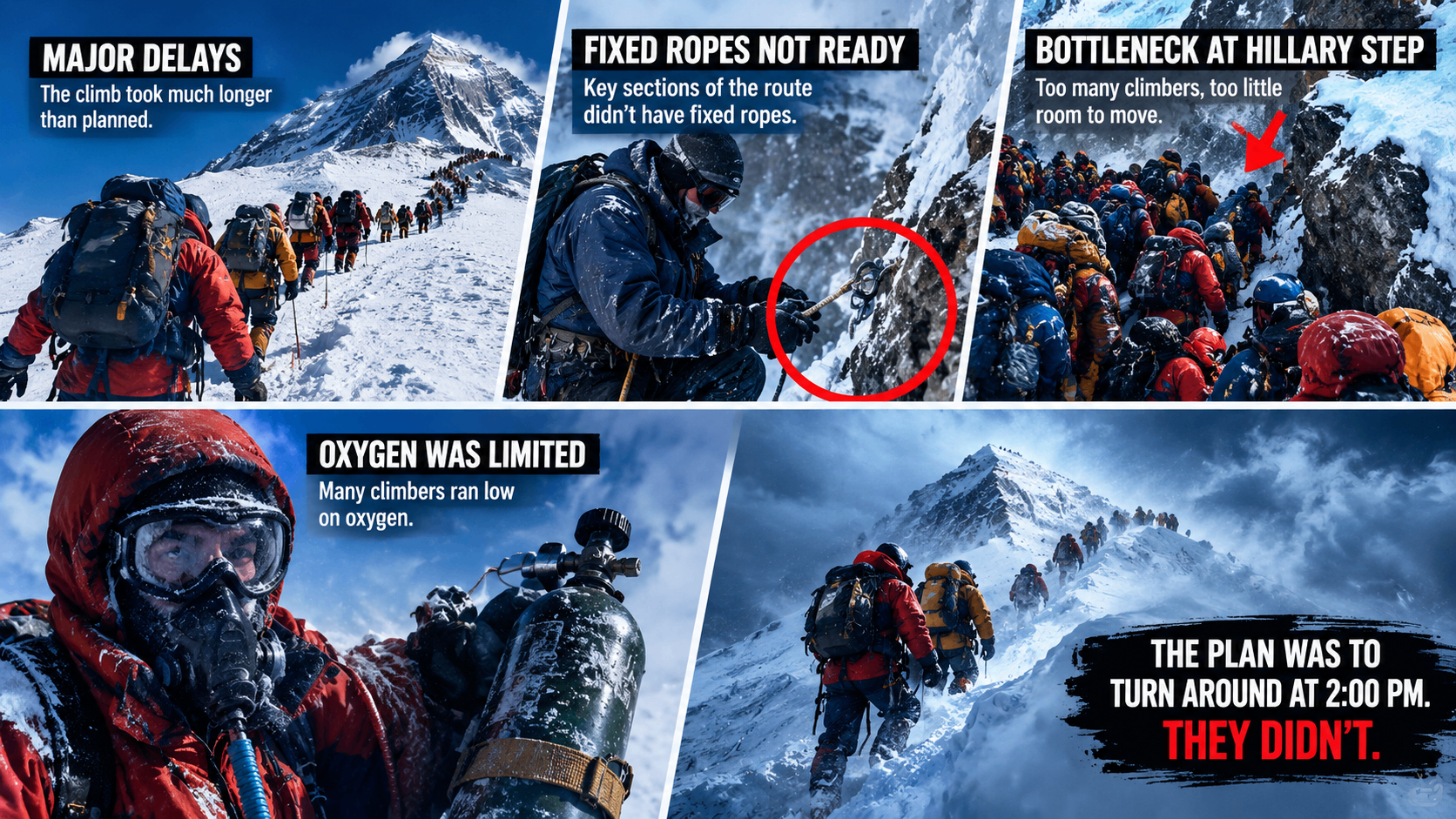
During the May 10, 1996 summit attempt, however, serious problems began accumulating. There were delays along the climbing route, including problems involving fixed ropes that were not ready when climbers reached important sections. Bottlenecks developed as climbers waited to move through difficult areas. Every delay mattered because people were climbing at extreme altitude with limited oxygen and a narrow window in which they could safely reach the summit and descend. The teams also had turnaround times intended to prevent climbers from remaining too high on the mountain too late in the day.
Yet some climbers continued upward as those turnaround times approached or passed. Experienced mountaineer Ed Viesturs, observing the climbers from below, later recalled wondering why they had not turned around. That question—why haven't they turned around?—became incredibly important
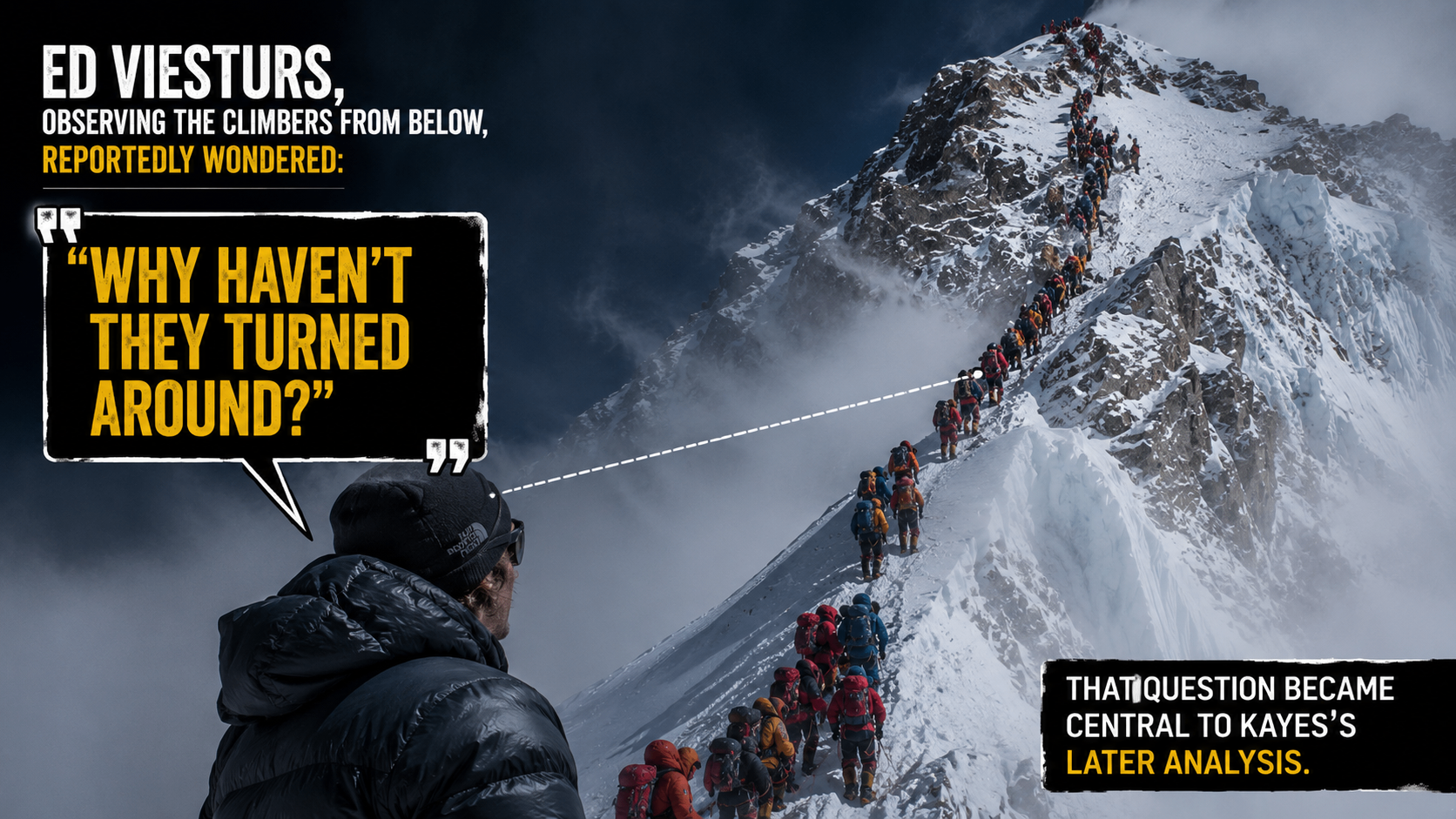
when looking at the disaster through the psychology of goal pursuit. From outside the pursuit, changing direction can appear obvious. From inside it, after enormous investment and with the summit seemingly within reach, turning around can feel almost impossible.
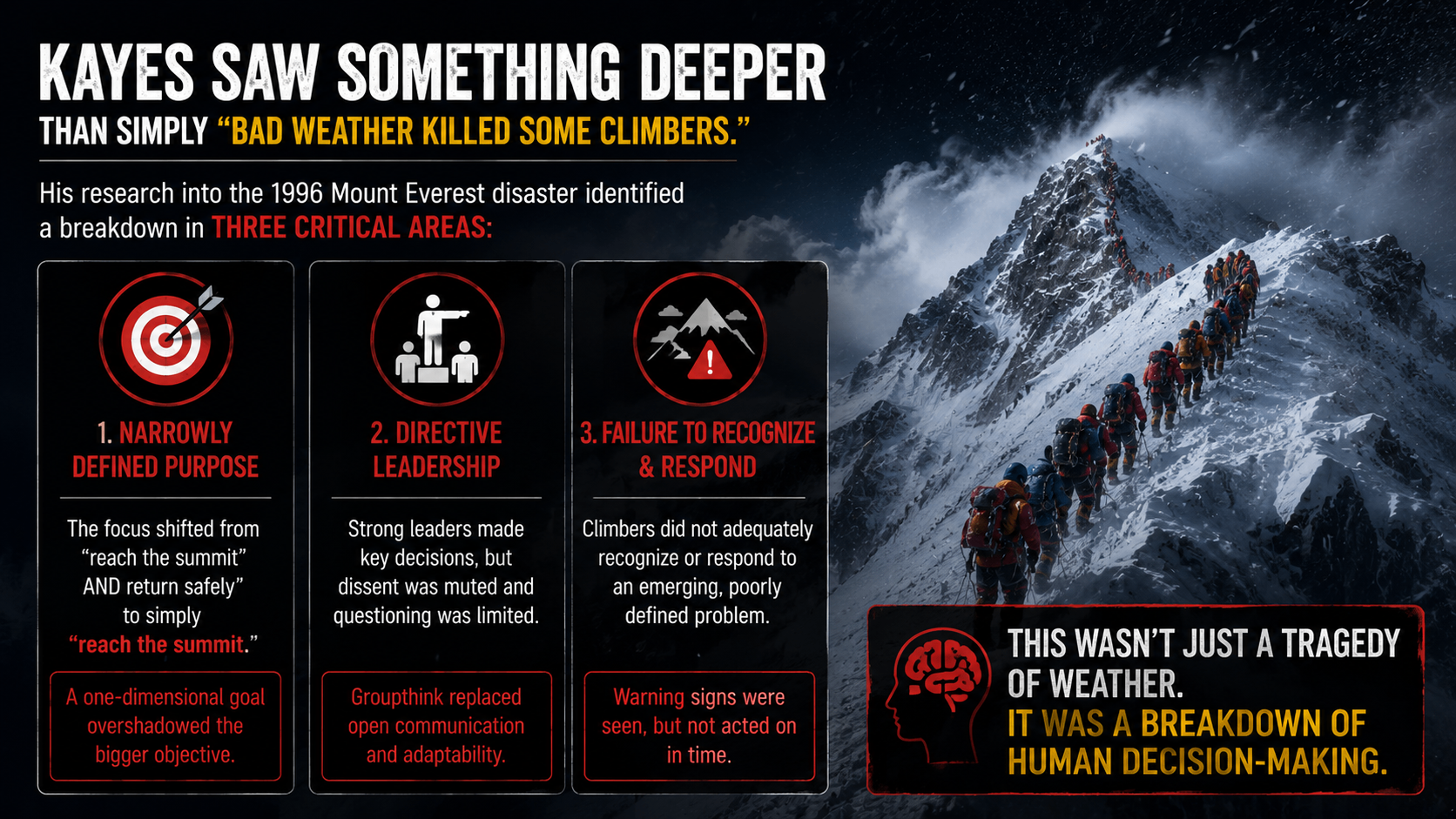
Conditions eventually deteriorated dramatically. A severe storm struck the mountain, climbers became stranded during the descent, and eight people died during the disaster. Kayes's analysis went beyond simply saying that bad weather caused a tragedy. His research examined the interaction between a narrowly defined goal, leadership, decision-making, changing circumstances, and the failure to adequately recognize and respond to an emerging problem. Everest became an extreme example of what can happen when an objective becomes extraordinarily powerful.
Most of us will obviously never find ourselves making a life-or-death decision near the summit of Mount Everest, but the underlying psychological question applies to ordinary goals as well. Someone can spend five years trying to make a business work, invest everything into a relationship, spend decades pursuing a particular career, or sacrifice enormous amounts of time and money for a dream. The more that person has invested, the harder it may become to objectively ask whether the current route still makes sense. Sometimes the hardest question isn't “How do I keep going?” It is “Why haven't I changed direction?”
How Does Goalodicy Hinder Success and Manifesting?
This is where Goalodicy becomes especially interesting because it initially appears to conflict with manifestation. Goalodicy suggests there are situations where the evidence around us should cause us to reevaluate the way we're pursuing a goal. Manifestation frequently teaches us not to allow the current 3D world to determine what's ultimately possible. If you have accepted a desired end internally, today's circumstances don't necessarily determine tomorrow's reality. You persist despite appearances.
That creates an obvious problem. Imagine you've spent several years trying to build a particular business and almost everything in your current reality says it isn't working. From the perspective of Goalodicy, those circumstances may contain information you need to seriously evaluate. From the perspective of manifestation, you might argue that reacting to those circumstances means allowing the 3D world to control your desired reality. So which one should you listen to?
I think the apparent contradiction begins disappearing when we separate the desired end from the path we've decided must create it. Suppose your real desire is financial freedom. There could potentially be hundreds of different ways financial freedom enters your life. A business could succeed, another opportunity could emerge, someone could introduce you to an entirely different industry, an idea you haven't had yet could become enormously successful, or your circumstances could change through a sequence of events you could never have predicted beforehand.
But suppose you decide that one particular business must be the thing that creates your financial freedom. Something important has changed. Your original desired end was financial freedom, but you've now psychologically connected that desired end to one specific vehicle. If that business repeatedly isn't working, you may interpret abandoning or changing the business as abandoning the manifestation itself. You can become so committed to making that particular vehicle work that you stop recognizing other opportunities appearing around you.
This is where Goalodicy can hinder both success and manifestation. The problem may not be that you're too committed to what you ultimately want. The problem may be that you've become too committed to how you've decided it must happen. That creates tunnel vision. You can overlook people, opportunities, ideas, strategies, and unexpected changes because they don't resemble the path you already decided was supposed to take you to the goal.
In manifestation language, persistence in the desired end is not necessarily the same thing as persistence in one particular bridge of incidents. If your destination remains the same, changing roads doesn't automatically mean you've abandoned the destination. That distinction allows Goalodicy and manifestation to coexist without requiring you to choose between blindly accepting the 3D world and blindly ignoring everything happening around you.

no fluff. no spam. just one weekly mindset drop to help you break patterns, shift identity, and take power back
No Spam.
Unsubscribe anytime.
But let's be real - you won't want to.
How to Get Goalodicy to Work in Manifestation
The solution to Goalodicy isn't necessarily becoming less committed to your dream. In fact, it may involve becoming even clearer about what the real dream actually is while becoming less attached to the route you've decided must produce it. You can remain committed to financial freedom without insisting that one business must create it. You can remain committed to a particular kind of life without insisting that one opportunity must deliver it. You can persist in the destination while becoming flexible about the road.
This is where surrender becomes important. Surrender is often misunderstood in manifestation as giving up on the desire or deciding that you no longer care whether it happens. But surrender can mean something completely different. You can still know what you want while surrendering your demand that you already understand how it has to happen. Instead of saying, “This business has to work or my manifestation has failed,” you can say, “Financial freedom remains my desired end, but I'm willing to allow the route toward it to change.”
That shift allows you to look at your current reality differently. The 3D world no longer has to be something you either completely obey or completely ignore. It can provide information without being allowed to define the ultimate limits of what's possible. If something repeatedly isn't working, you don't automatically have to conclude that your dream is impossible. You can simply ask whether this particular route is still serving the destination.
That also creates room for intuition. An opportunity may suddenly appear that doesn't resemble your original plan. You may feel compelled to contact someone, move somewhere, start something new, stop doing something you've been forcing, or explore an idea that initially seems unrelated to the goal. When you're psychologically attached to one predetermined route, those events can look like distractions. When you've surrendered the how, they may look more like possible bridges.
Goalodicy can therefore become useful within manifestation because it gives you a checkpoint. When you find yourself forcing something harder and harder, you can ask whether you're persisting in your desired end or merely persisting in your preferred method of achieving it. Those are not necessarily the same thing. Sometimes maintaining faith in the destination may actually require enough flexibility to release the road you originally believed would take you there.

Power wealth classics
Struggling to achieve financial freedom or live the life you deserve? Power Wealth Classics is your ultimate guide to timeless principles of success and abundance. Available now on Amazon, this book combines proven strategies and insights from history's greatest minds to help you break free from limitations, build wealth, and create lasting prosperity. Don’t wait—transform your life today!
Goalodicy, the 3D World and Surrender
One of the biggest mistakes would be assuming that there are only two choices: either accept everything your current 3D reality tells you and abandon your desired end, or ignore absolutely everything happening in your current reality and continue doing exactly what you've been doing. There is a third possibility. You can refuse to allow present circumstances to define what is ultimately possible while still allowing those circumstances to inform the decisions you're making right now.
If a business fails, that doesn't automatically mean financial freedom is impossible. It may simply mean that particular business wasn't the vehicle. If an opportunity disappears, the desired end doesn't necessarily disappear with it. If one strategy repeatedly fails, changing strategies doesn't automatically mean you've stopped believing in the goal. The destination and the route are separate things, and confusing the two can make surrender feel like failure when it may actually be flexibility.
This is why Goalodicy can add something valuable to manifestation rather than simply contradicting it. You don't necessarily surrender the what; you surrender your insistence upon the how. You remain open to the possibility that the bridge leading toward what you want may look completely different from the bridge you originally imagined. Instead of forcing life to follow your predetermined route, you become capable of recognizing other routes when they appear.
Final Thoughts
The question “What is Goalodicy?” ultimately leads to a much bigger question about success and manifestation: when does persistence stop helping us and start preventing us from seeing other possibilities? There isn't a universal answer. Sometimes circumstances will look terrible, progress will appear nonexistent, everyone around you will tell you to stop, and persistence will be exactly what eventually produces the breakthrough. That's why blindly quitting whenever the 3D looks unfavorable isn't the answer either.
But persistence shouldn't require blindness. You can remain deeply committed to what you ultimately want while continuously reevaluating the route you're taking toward it. Your dream may remain exactly the same while the business changes, the strategy changes, the opportunity changes, the relationship changes, the location changes, or the entire bridge leading toward that dream changes.
Maybe the deepest lesson of Goalodicy isn't simply knowing when to quit. Maybe it's learning to recognize the difference between quitting your desired life and releasing your attachment to the way you thought that life had to happen. In manifestation, that distinction can allow persistence and surrender to exist at the same time.
🔗 Related Resources

Chad Napier
I'm here to help you unlock Wealth, Health & Prosperity by mastering your mindset and living life on YOUR terms. If you're ready to break free from the ordinary—you’ve found your Tribe.